
Roscosmos, Russia’s space agency, has indeed presented a model of the commercial module for its planned Russian Orbital Station (ROS). This module is part of the broader plan to build ROS, which is intended to replace the International Space Station (ISS) as Russia’s primary space station. Within the framework of the International Military-Technical Forum, representatives of Roscosmos showed a model of the commercial module of the Russian Orbital Station (ROS).
The ROS is an ambitious project that involves the creation of a new orbital station for scientific research and other tasks. It involves the launch of several modules, including scientific and energy, universal node, gateway and base. Investments in the ROS will amount to 608.9 billion rubles, of which 150 billion rubles will be spent in the first three years. Yury Borisov, the head of Roscosmos, has approved a comprehensive schedule for the creation of the Russian Orbital Station (ROS), slated for completion by 2033.
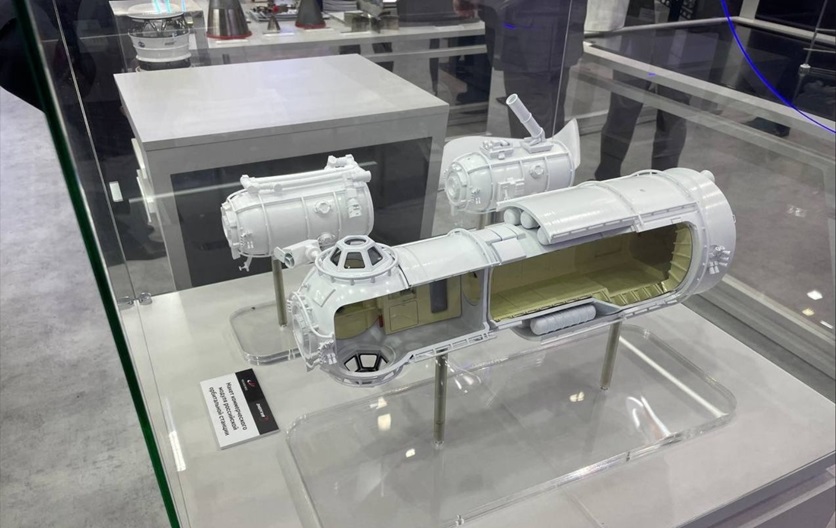
The photo shows a special module with two observation windows. Also, according to the company, it can be equipped with a telescope or robotic arm. Russia’s State Space Corporation Roscosmos has announced the timeline to build its independent space station as the International Space Station comes close to end of life. Yury Borisov, the head of Roscosmos, has approved a comprehensive schedule for the creation of the Russian Orbital Station (ROS), slated for completion by 2033. This announcement was made by Roscosmos’ press office on Tuesday.
The approved schedule outlines the launch of the first research and energy module in 2027. This will be followed by the deployment of the universal nodal, gateway, and baseline modules by 2030, forming the core of the orbital station. The project will then enter its second stage from 2031 to 2033, during which two special-purpose modules (TsM1 and TsM2) will be docked to the station.
The ambitious project is estimated to cost 608.9 billion rubles (approximately $6.98 billion). Roscosmos recently also signed contracts to commence research and development work on the space segment of the orbital outpost, the next-generation manned spacecraft, and the Angara heavy carrier rocket that will service the station.
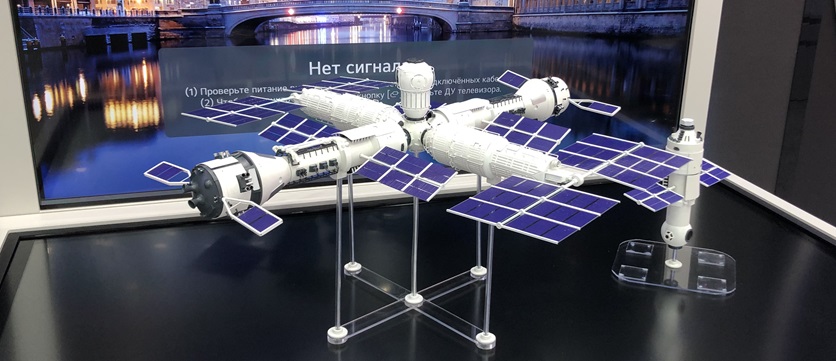
In the photo above, Roscosmos showed a model of the station following the results of the second stage of deployment. According to the approved schedule, the deployment of the ROS in a near-polar orbit is expected in the period from 2027 to 2033. First, it is planned to send a scientific and energy module into orbit – its launch is scheduled for the end of 2027. Next, the universal node, gateway and base modules will be launched: all together they will form the core of the station and will begin operation no later than 2030. Then, from 2031 to 2033, it is planned to dock two target modules, which will imply the second stage of deployment.
WHAT IS THE RUSSIAN SPACE STATION?
Roscosmos presented a model of the planned space station, dubbed “ROSS” at “Army-2022”, a military-industrial exhibition outside Moscow.
Roscosmos in a statement said that the new space station would be launched in two phases and that the first phase would see a four-module space station begin operations and science experimentation. This will be followed by a further two modules and a service platform and, when completed, it would be capable of housing up to four cosmonauts as well as scientific equipment.
The space station plans show Russian prowess in building their own orbital outpost, especially with the experience of living and working on the ISS for over two decades. Russian state media have suggested that the launch of the first stage is planned for 2025-26 and no later than 2030. The launch of the second and final stage is planned for 2030-35, they reported.
Roskosmos has said the new station would afford Russian cosmonauts a much wider view of the Earth for monitoring purposes than they enjoy in their current segment. Reports indicate that the Russian station, unlike the ISS will not have a permanent human presence and that it would be staffed twice a year for extended periods.
WHY GO ALONE?
The plans to construct its own space station have been in the works in Moscow for a while, and the Ukraine war followed by western sanctions pushed it ahead. Moscow is pushing to reduce its dependency on Western nations and forge ahead on its own or cooperate with countries like China and Iran when it comes to space exploration.
Meanwhile, the West has accused Russia of prosecuting an unprovoked imperial-style war of aggression against Ukraine and imposed harsh sanctions aimed at breaking the Russian military modernisation and space campaigns. Yuri Borisov, whom President Vladimir Putin appointed last month to head Roskosmos, has said Russia will quit the ISS after 2024 and is working to develop its own orbital station.
The ISS has been a hub of international experiments, deep space exploration campaigns, and a center to test future science required by humans in their campaigns on Moon and Mars.
Russia’s State Space Corporation Roscosmos has announced the timeline to build its independent space station as the International Space Station comes close to end of life.
Yury Borisov, the head of Roscosmos, has approved a comprehensive schedule for the creation of the Russian Orbital Station (ROS), slated for completion by 2033. This announcement was made by Roscosmos’ press office on Tuesday.
The approved schedule outlines the launch of the first research and energy module in 2027. This will be followed by the deployment of the universal nodal, gateway, and baseline modules by 2030, forming the core of the orbital station. The project will then enter its second stage from 2031 to 2033, during which two special-purpose modules (TsM1 and TsM2) will be docked to the station.
The ambitious project is estimated to cost 608.9 billion rubles (approximately $6.98 billion). Roscosmos recently also signed contracts to commence research and development work on the space segment of the orbital outpost, the next-generation manned spacecraft, and the Angara heavy carrier rocket that will service the station.
The general schedule includes flight tests of new spacecraft, the creation of carrier rockets, and the development of ground infrastructure facilities. It also involves work by the space industry’s research institutes to provide support for the project.
The concept of the Russian Orbital Station was first proposed in April 2021. By October of the following year, Roscosmos Chief Borisov estimated the project cost at 609 billion rubles until 2032, with 150 billion rubles (about $1.7 billion) allocated for the first three years.
The project is open to international cooperation, with Russia inviting African countries and BRICS member states to participate in the station’s creation.
The ROS is expected to continue Russia’s human spaceflight program, particularly in light of its planned exit from the International Space Station (ISS) project. The new station aims to address scientific, technical, economic, and security tasks that are currently constrained by technological and international agreements on the ISS.
The Russian Orbital Service Station would orbit at the same altitude as the International Space Station, around 250 miles (400 km) above Earth, in a polar, sun-synchronous orbit. The route is particularly useful for observing the entire surface of the planet, according to Roscosmos, and also provides a valuable view over “the strategically important Northern Sea Route.” The estimated cost is about $7 billion USD.
Additionally, the ROS will enhance the competitive edge of Russian manned space systems and facilitate the practice of advanced space technologies.
This development marks a pivotal step for Russia as it seeks to maintain its legacy in space exploration and bolster its capabilities in the face of evolving global dynamics.