
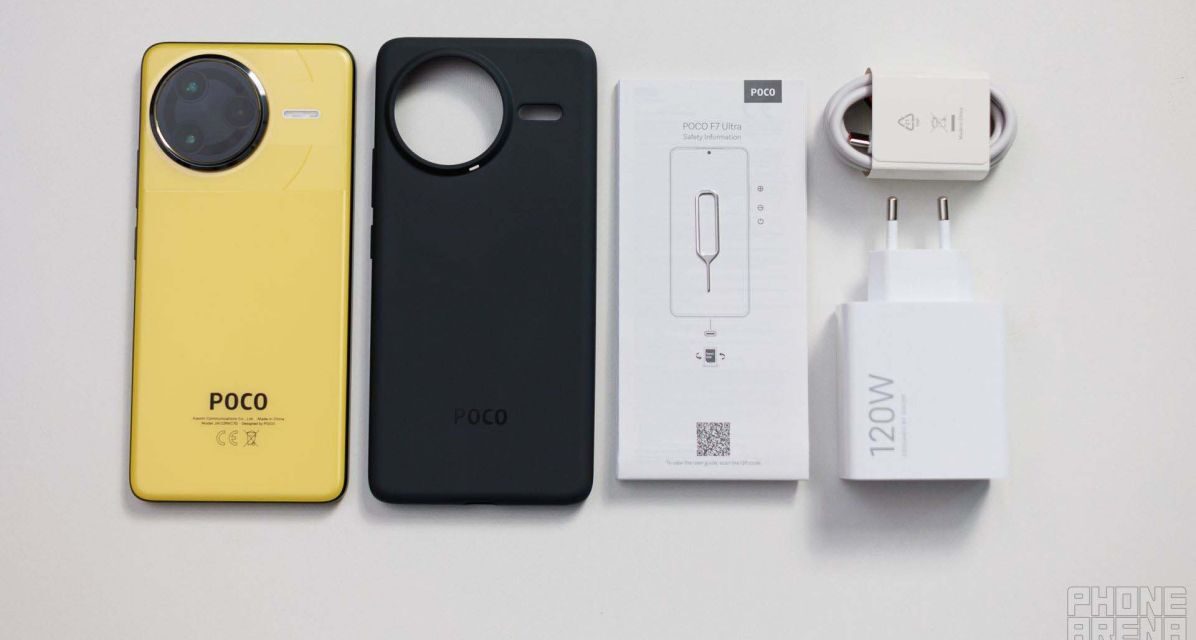
The POCO brand has always made compromises to ensure that smartphones released under it remain affordable. Even top-end models usually received the flagship chips of the previous generation. But this year, the company released an “ultimate” model for the first time. Let’s figure out what the POCO F7 Ultra is.
Glass, flat edges and water resistance
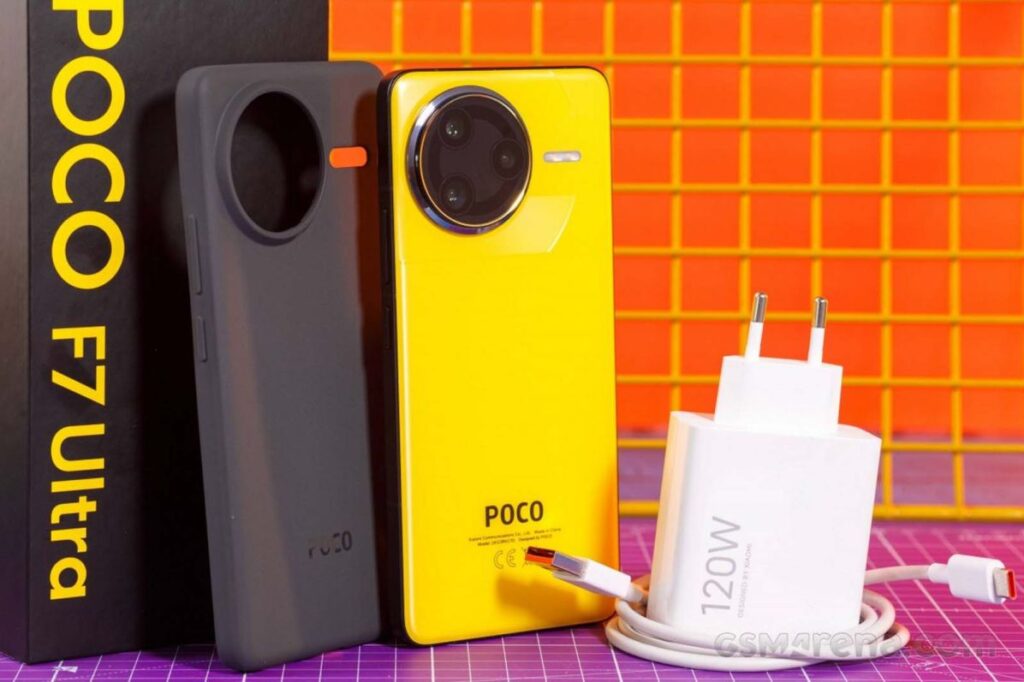
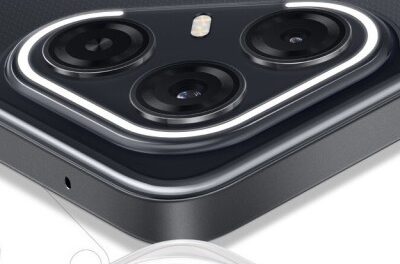
Externally, this is a copy of the Redmi K80 Pro released in China, except that the color of the case is different here, and a discreet pattern is visible near the round block of cameras. The smartphone comes with a graphite-colored silicone case, a USB-A to USB-C cable and a 120W adapter. But the availability of the latter depends on the market conditions in a particular country.
The back cover is made of glass and is visually divided into two parts: the lower matte and the upper glossy. The glass is curved at the edges, which improves the ergonomics of the device, taking into account the flat side edges. The screen is covered with POCO Shield Glass. Time will tell if this is a worthy alternative to Gorilla Glass.
A fast ultrasonic fingerprint scanner is built into the screen. Not only does it work accurately, but it is also at a comfortable height, which is rare for Chinese devices.
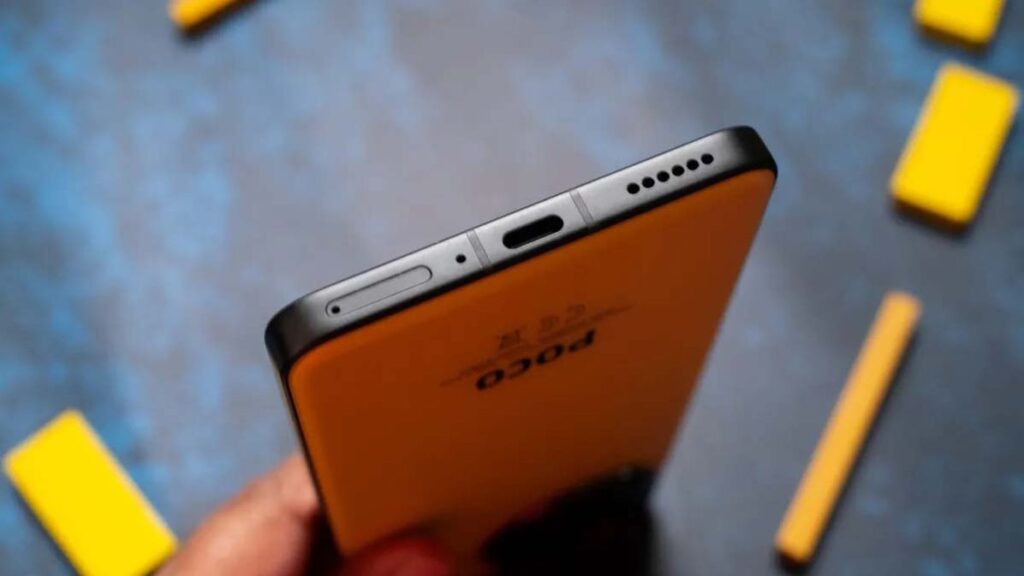
At the bottom there is a slot for two physical SIM cards, but the model does not support eSIM. There is also a USB Type-C port of the slow USB 2.0 standard. The smartphone has IP68 protection and the ability to withstand immersion in water to a depth of 2.5 meters – more than the standard limit of one and a half.
Flagship picture
The display of the POCO F7 Ultra is similar to the one found in the POCO F6 Pro, but with some improvements. It’s a 6.67-inch AMOLED matrix with a resolution of 3200 x 1440 pixels and 12-bit color depth, which means it can display 68 billion shades. Gorilla Glass 5 was replaced by POCO Glass.
For the POCO F6 Pro, a peak brightness of 4000 nits was claimed, while for the POCO F7 Ultra it was 3200. But this value is for HDR content with a minimal portion of the active screen. At the same time, the declared maximum brightness for normal use has been increased from 1200 to 1800 nits. Tests with the measuring device show that with manual adjustment and with Sunlight mode active, the Ultra model’s screen produces up to 900 nits, with automatic adjustment – about 1500, and with 20% of the active screen – almost 3000. There are no problems with visibility even in sunny weather.
Unfortunately, the POCO F7 Ultra does not have an LTPO panel – there is no dynamic adjustment of the refresh rate and down to 1 Hz. Depending on the use case, only 60 Hz or 120 Hz can be obtained. In automatic mode, the system selects the refresh rate of the screen itself, but if you turn on constant 120 Hz, you can manually set the frequency for each specific application. For example, force some programs to always run at 120 Hz, and others at 60 Hz.
Hello Telephoto
One of the main compromises of POCO smartphones has always been cameras. In the case of the POCO F7 Ultra, the manufacturer was generous with a TV camera for the first time. However, it is without a periscope lens – it is a 50 MP sensor with 2.5x zoom and support for macro photography from a distance of 10 cm. For comparison, the Xiaomi 15 uses a more advanced Light Fusion 900 matrix. The third rear camera is a 32 MP ultra-wide with a 120-degree viewing angle. The same resolution is for the front camera.
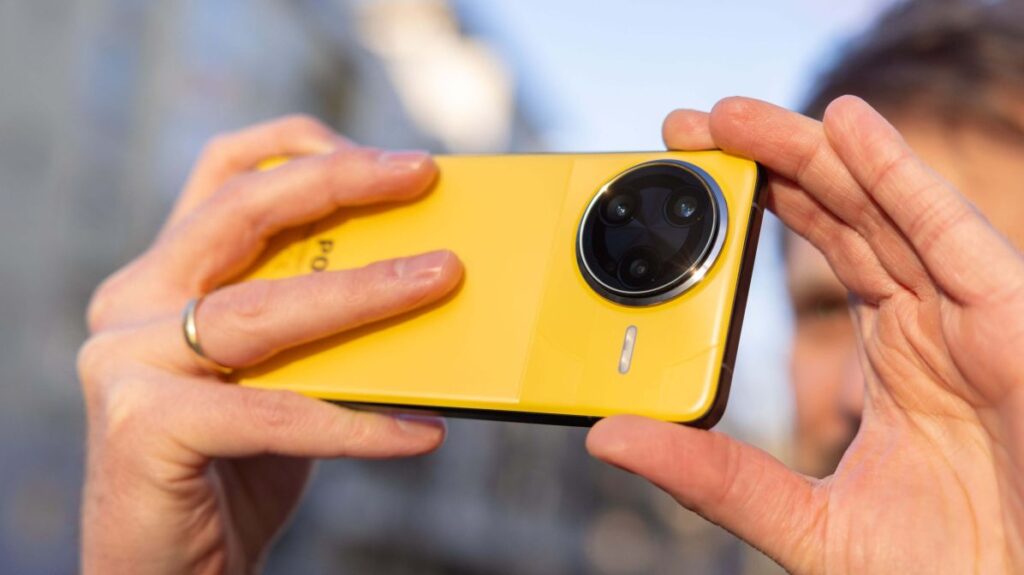
During the day, the rear camera takes decent pictures in terms of contrast, saturation, dynamic range, and white balance. The detail is also at a high level, but when you zoom in, you can see the work of the algorithms, especially on grass and other complex textures. The smartphone does a good job with portraits, although when choosing the 35 mm mode, you will have to sacrifice a little detail.
At 2x zoom, the smartphone crop from the sensor, so the photos are not inferior in quality to those taken without zoom. When switching to a TV camera with a 2.5x zoom, we get a slightly closer approximation, but with excellent detail. Even with a 5x zoom, the pictures are suitable for publication on social networks.
The manufacturer claims the possibility of shooting on a TV camera in macro mode with a minimum focal length of 10 cm, but in practice you can shoot from about 8.5 cm.
The ultra-wide-angle camera is devoid of autofocus, which does not allow you to shoot at close range. There is also a lack of resolution if you consider the frames in magnification.
The rear camera supports video recording up to 8K at 24 fps or 4K at 60 fps. A maximum of 4K at 60 fps is available for the TV camera, while 1080p at 60 fps is available for the ultra-wide-angle and front cameras. Not at all flagships.
If you shoot with the main camera, the video is generally of good quality, detailed. The picture from the telephoto lens is less sharp and slightly overexposed, and the situation is even worse on the ultra-wide and front camera.
The stabilization works well, although a slight shaking while walking is still noticeable. For the smoothest possible picture, there are Shoot Steady and Shoot Steady Pro modes, but they are limited to 1080p at 30 fps and are only available for the main and ultra-wide-angle cameras.
Top “dragon”
The current flagship Snapdragon 8 Elite was chosen as the POCO F7 Ultra processor. In the Geekbench 6 benchmark, the device scores about 3000 points in single-core mode, which is comparable to other smartphones on this chip, but in multi-core it turns out to be about 8900. For comparison, the iQOO 13 and realme GT7 Pro give out about 9500 points.
After 45 minutes of watching an online video, scrolling through social networks, a video call and a short gaming session, the smartphone discharges from 100 to 97%. And in three hours of watching YouTube in full-screen mode with maximum screen brightness and Wi-Fi connection – up to 87%. For an entire day of moderate use with about 4 hours of active screen, a little more than 50% of the charge remains in the evening. The autonomy figures are very close to what the base Xiaomi 15 demonstrates.
When using a proprietary 120-watt adapter, the smartphone charges from zero to about 55% in 15 minutes. It takes up to 35 minutes to fully replenish energy. With 100W third-party Power Delivery charging, it manages to reach 100% in about 57 minutes.
POCO F7 Ultra Specifications
- DISPLAY
- 6.67″, AMOLED, 3200×1440 resolution, refresh rate up to 120 Hz, peak brightness 3200 nits, HDR10+, Dolby Vision, 3840 Hz PWM
- CHIPSET
- Qualcomm Snapdragon 8 Elite, 3nm, 4.32GHz
- RAM AND STORAGE
- 12/16 GB, LPDDR5X
256/512 GB, UFS 4.1 - ACCUMULATOR
- 5300mAh, 120W wired charging, 50W wireless charging
- CAMERA
- Wide Angle – 50 MP, Light Fusion 800 Sensor, f/1.6, OIS, 8K @ 24 fps
, Ultra Wide Angle – 32 MP, f/2.2, 120 degree
telephoto – 50 MP, f/2.0, 2.5x zoom, OIS, 10 cm, macro
front – 32 MP, f/2.0, 1080p @ 60 fps - CONNECTION
- 5G, Wi-Fi 7, Bluetooth 6.0, GPS (L1 + L2), NFC, USB Type-C, IR
- FEATURES
- Ultrasonic Under-Screen Fingerprint Scanner, Stereo Speakers, IP68 Protection
- DIMENSIONS AND WEIGHT
- 160.3 x 75 x 8.4 mm
212 g
Instead of results
Despite the name, the POCO F7 Ultra is unlikely to be considered outrageous. It has a top-end processor and an excellent screen, but at the same time, the cameras are clearly inferior to the flagships of other brands and even Xiaomi 15 Ultra. Video recording on the front camera in a maximum of 1080p, a slow USB 2.0 port, the absence of a 1 TB modification, a reduced battery capacity – all these are compromising that the manufacturer made for the sake of a reasonable price.


![Google Pixel 9 Pro XL [VIDEO]](https://gizmodazzle.com/wp-content/uploads/2024/08/google_pixel.jpg)

