
Although we usually think about music as an auditory medium, transcribing music to a readable format is a critical part of the production process for many songwriters, composers and instrumentalists. By transcribing a song, it becomes easier to share it with other musicians and to recreate it in future performances. However, manually transcribing music can be tedious and time-consuming. That’s why many musicians choose to take advantage of AI-powered music transcription tools.
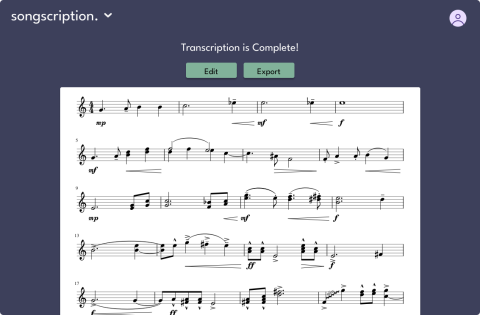
A small company called Songscription launched last week with AI models that automate music transcription, turning an audio file of a song into sheet music within minutes. Operating on a freemium model, the product is geared toward both professional and hobbyist musicians.
Songscription startup has launched an online application that can convert music into sheet music using AI. The developers talked about how it works, what else it can do and who may need it.
Understanding AI Music Transcription
AI music transcription technology has evolved significantly over the last several years and has revolutionized the music transcription and notation process along the way. These software solutions use advanced learning models to take audio input and convert it to written sheet music. We don’t often think about the role of machine learning in music, but today’s musicians have a commanding arsenal of AI-powered tools at their disposal to help in their composition and production processes.
“We hope to make playing music more enjoyable,” Andrew Carlins, CEO of Songscription and a student in Stanford’s MBA/MA in Education program, told TechCrunch. “We imagine a future where a rural Nebraska high school band teacher [will be] able to get sheet music for the songs their students want to play, [and] that said music will be arranged specifically for the instruments in the band and offered at the individual level of play of each student.”
At launch, Songscription can transcribe music for several different instruments, though the piano model is most reliable. In the future, the company hopes to add different transcription outputs (e.g., guitar tabs), as well as arrangements for a full band as opposed to just one instrument.
Automatic Music Transcription Techniques
This kind of product could be useful for a musician who records a song they’re working on, then uploads it to get the sheet music — that way, they can skip the step of having to manually transcribe their work. And for those who can’t read and write sheet music, Songscription will also generate a piano roll, which shows a digital representation of the music being played on a virtual piano.
Users can also automate music transcription directly from YouTube links. Uploading a file requires users to check a box to confirm that they have the rights to transcribe the file, but it would be easy to simply check the box and get free sheet music for copyrighted songs.
Most AI music transcription tools basically perform audio to sheet music conversion. Essentially, these tools allow users to upload an audio recording that the AI then analyzes and convert into sheet music. To accomplish this task, the AI must undergo training to properly identify different musical notes and their durations with pitch detection algorithms and other types of music analysis technology. The software must also be capable of assigning the corresponding music notation symbols to these elements and arranging them into a properly formatted piece of music.
Some music transcription software solutions work a little bit differently. Rather than generating sheet music from an audio recording, these tools instead convert audio files to MIDI files. MIDI files function more like sets of digital protocols and essentially encode the various elements of an audio recording into a file format that users can easily edit and manipulate with MIDI-compatible devices.
Converting an audio recording to a MIDI file can help a writer or producer render their rough recordings into more streamlined tracks that are easier to work with and share with other musicians during the production process. Many AI transcription tools can also generate sheet music from MIDI files to improve accuracy, further streamlining the digital music notation process.
Benefits of AI Music Transcription
“For music learners … since you are allowed to listen to a song, write down the notes by ear, and perform it on your home piano (as long as you don’t charge for a performance), it isn’t fully clear that using a tech-enabled platform to give you a head start crosses any legal boundary, although we understand the field is evolving and our application may enter a gray area,” Carlins said.
Automatic music transcription technology is one of the most valuable recent innovations in music technology. The manual music transcription process can be pain-staking and laborious, especially for musicians without advanced knowledge of music theory and notation. AI music transcription tools can make this process more efficient and accessible to musicians and writers of all backgrounds, abilities and means.
There’s no shortage of music industry technology already involved in the production process, but incorporating AI in music production can save professionals valuable time and resources. Using AI to produce sheet music can help to ensure everyone who works on a recording project has access to the most accurate and easy-to-follow version of a composition while saving producers and artists the cost of hiring a professional to transcribe their music by hand.
Songscription is based on neural network models trained on sheet music and compositions from open sources and specially purchased data. The service turns a music file into sheet music “in a matter of minutes” and works with various musical instruments, but best of all, with the piano. In the future, it should be possible to create guitar tablature and even orchestral arrangements with multiple musical instruments.
Songscription is designed for creative people who record their own music: you can play a song and quickly translate it into notes. The service also knows how to turn sheet music into music, which is useful for novice musicians and teachers. In addition to an external sound source, the application can be fed a link to a YouTube video, and the program will return sheet music.
Songscription has already received funding from venture capital firm Reach Capital and a spot in Stanford’s StartX business accelerator. The free version offers recognition of 30-second segments, and the subscription costs $29 per month.